
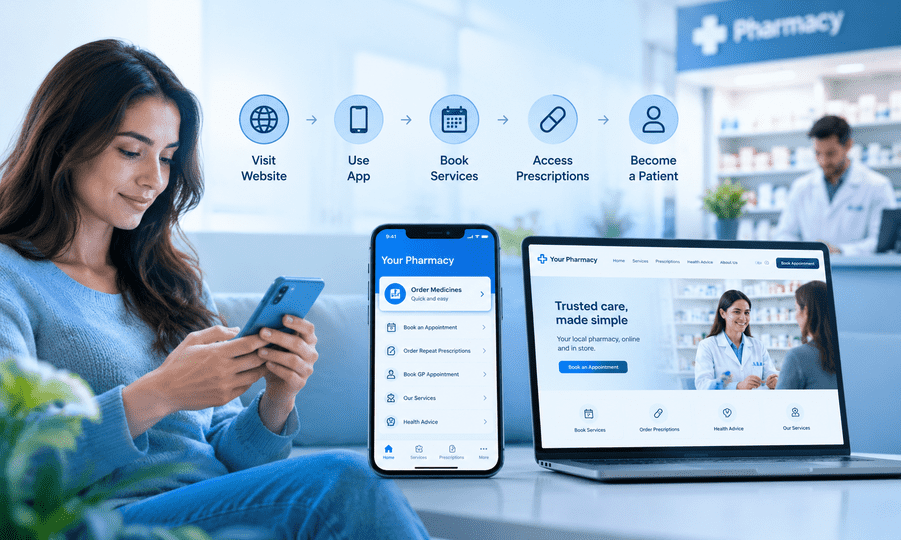
A visit is not a patient
Every day, people land on community pharmacy websites looking for something specific. They want to know if you offer Pharmacy First, whether you can do their flu jab on Saturday, or how to get their repeat prescription without standing in a queue. Most of them leave without doing anything.
That is not because they chose another pharmacy. Usually it is because the website gave them information but no next step. A phone number, an opening times table and a list of services is a noticeboard, not a journey.
The pharmacies that are growing in 2026 treat their digital presence differently. They see it as the front door to a relationship: book, order, collect, follow up, and come back. This post walks through what that journey looks like, where it usually breaks, and how to build one that turns a curious visitor into a loyal patient.
Where the journey usually breaks
Most pharmacy websites lose people at the same handful of moments. Spotting them is the first step to fixing them.
- "Call us to book." A patient reading about Pharmacy First at 9pm cannot call. By morning, the moment has passed, and the consultation (and the fee that comes with it) goes somewhere else.
- No way to act on a service page. Pages that describe NMS, DMS or hypertension case-finding without a booking button explain the service but never deliver it.
- Repeat prescriptions that disappear into a black box. Patients order, then hear nothing. They phone to ask, or turn up at the counter, adding to the queue the digital route was meant to remove.
- Shortage news that arrives too late. When a medicine is out of stock, patients often find out at the counter. That is a frustrating experience and a costly one for staff time.
- One visit, then silence. A patient books a flu jab or a blood pressure check and never hears from the pharmacy again, even when they are eligible for another service.
Each of these is a gap between what the patient wanted to do and what the pharmacy made possible. Close them, and the website stops being a brochure and starts doing real work.
The journey, stage by stage
A good digital pharmacy journey has six stages. Each one should hand the patient smoothly to the next.
1. Discovery: be findable for the right reasons
Patients search for problems, not pharmacy jargon. They type "sore throat pharmacy near me" or "flu jab this weekend", not "clinical pathway". Write service pages around those questions, in plain English, and make sure each page answers who the service is for, what happens, and how long it takes.
2. First contact: give every page a next step
Every service page should end with one clear action: book, order or download the app. If a visitor has to hunt for a phone number, you have already lost part of the audience. Put the booking button where the reading stops.
3. Booking: let patients choose the slot themselves
Self-service booking for Pharmacy First, NMS, DMS, vaccinations and blood pressure checks does two things. It captures demand outside opening hours, and it protects consultation time from being crowded out by walk-ins. Staff know what is coming, and patients know they will be seen.
4. Prescriptions: make the status visible
Repeat ordering works best when patients can see where their prescription is without asking. Clear EPS nomination guidance, a simple reorder flow and live order status answer the "is it ready yet?" question on the patient's phone instead of at your counter.
5. Collection or delivery: finish the job properly
Whether the patient collects or has medicines delivered, the last step should be as reliable as the first. Tracked delivery, identity checks at the door and proof of delivery protect the patient and give the pharmacy a clean record.
6. Follow-up: turn one visit into a relationship
This is where most pharmacies stop, and where the real value begins. A post-discharge patient may be eligible for DMS. A flu jab patient may benefit from a hypertension check. A weight management patient needs a structured follow-up consultation. Timely, relevant reminders bring patients back for care they actually need.
Build compliance into the journey, not around it
A better digital journey is not only about convenience. Done well, it makes GPhC standards easier to meet every day, not just on inspection day.
- A traceable patient journey. When bookings, consultations and deliveries are logged automatically with timestamps, the evidence inspectors ask for already exists. It is not sitting in one person's head or a paper diary.
- Distance selling done right. GPhC's guidance on pharmacy services provided at a distance (February 2025) sets expectations for identity checks, secure and traceable transport, and clear escalation routes. A delivery process with proof of delivery supports all three.
- Confidentiality by design. Clinical questions handled over personal WhatsApp or unsecured text are a quiet but real risk. Secure, encrypted patient messaging with multi-factor authentication replaces those habits with something built for healthcare.
- Follow-up that is documented. GPhC's April 2026 review of weight management services highlighted follow-up as a common weak point. Scheduled reminders create the documented touchpoints that good practice requires.
As with any change touching clinical services, have your superintendent pharmacist review your processes against current GPhC standards.
Why this matters most for independents
Independent pharmacies already have what the big chains spend fortunes trying to build: trust, local knowledge and patients who know the pharmacist by name. What they often lack is the digital convenience that makes patients stay.
When a patient can book, reorder and track a prescription in a chain's app but has to phone their local independent, convenience tends to win over loyalty. That is rarely a conscious choice. It just happens, one repeat prescription at a time.
There is a funding case too. With the 2026/27 CPCF settlement landing against rising costs, pharmacies that stay healthy are growing revenue beyond dispensing. Advanced services, private consultations and OTC sales all depend on patients being able to find and book them easily. A strong digital journey is how an independent competes on convenience while keeping its own name on every screen.
A quick checklist for your pharmacy
Use this to see how your current journey measures up.
- Every service page ends with a clear "book now" or "order now" action
- Patients can book Pharmacy First, NMS, DMS and vaccinations outside opening hours
- Repeat prescription status is visible without a phone call
- Stock and substitution updates reach patients before they reach the counter
- Deliveries are tracked, identity-checked and recorded with proof of delivery
- Patient messaging is encrypted and kept off personal messaging apps
- Eligible patients are reminded about follow-up and seasonal services
- Every booking, consultation and delivery leaves a timestamped record
How AppandTap brings it together
AppandTap gives community pharmacies a branded app that covers the whole journey in one place. Patients book Pharmacy First, NMS and vaccination slots directly, reorder repeat prescriptions and see live order status. The Pharmdel delivery integration adds tracked routes, identity checks and timestamped proof of delivery. Targeted push notifications reach eligible patients at the right moment, from post-discharge reminders to flu season campaigns.
Every screen carries your pharmacy's name, not ours. The result is a journey that starts with a website visit and keeps going: booked, served, followed up, and back again.